Guitar Picking Technique Exercises – How to Improve Guitar Picking Accuracy FAST 🎯🔥
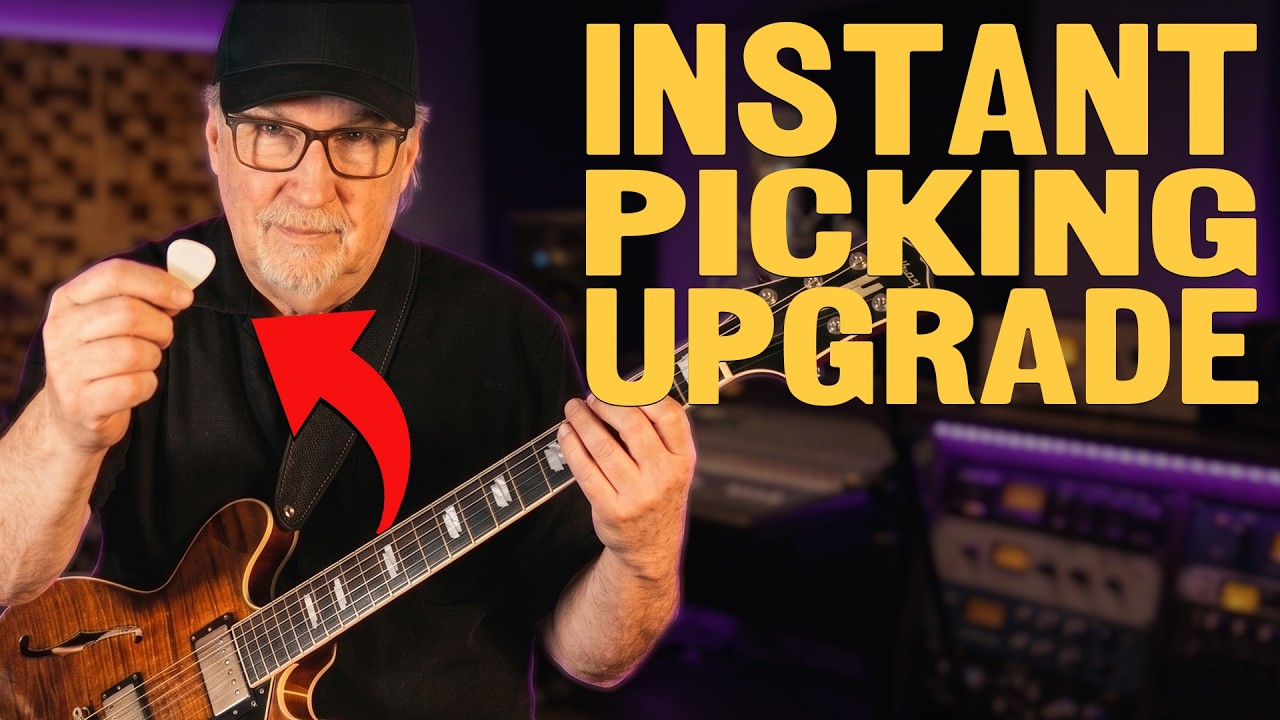
► Watch the full lesson on YouTube
If your picking feels stiff and your solos won't flow, the culprit is usually a few habits in your right hand. This lesson covers the two essential picking systems — alternate picking and economy picking — and how to move smoothly across the strings.
What you'll learn
- Hold the pick between your thumb and first finger — never the second
- Alternate picking is strict down-up-down-up
- Economy picking uses three notes per string, following through with a downstroke
- Practice in even eighth notes until the motion becomes automatic
How to hold the pick
Hold the pick between your thumb and first finger, with the tip lined up roughly along the cuticle of your thumb. It doesn't have to be perfect, just in that area. The big no-no Adam sees players do all the time is holding the pick between the thumb and the second finger — that gets you into a lot of trouble.
Alternate picking
Alternate picking simply means the pick goes down, up, down, up as you play through a passage. Using a G major scale in second position — first finger hovering over the second fret — play through the scale watching the right hand go down-up, down-up. This is the standard method, and the one Adam first learned at Berklee.
Economy picking — three notes per string
Economy picking puts an odd number of notes — use three — on each string. Starting on G with the first finger, play G, A, B on the low E string. When you play the A, stretch out with the second finger rather than the third, which leaves the pinky in position to grab the B easily.
The picking is down, up, down — then instead of bringing the pick back around the string, you follow through with another downstroke onto the next string. It's very fluid. And because it's always three notes per string, you remove the confusion of alternate picking, where you're sometimes on two notes and sometimes on three. Every time you move to a new string, start with the first finger.
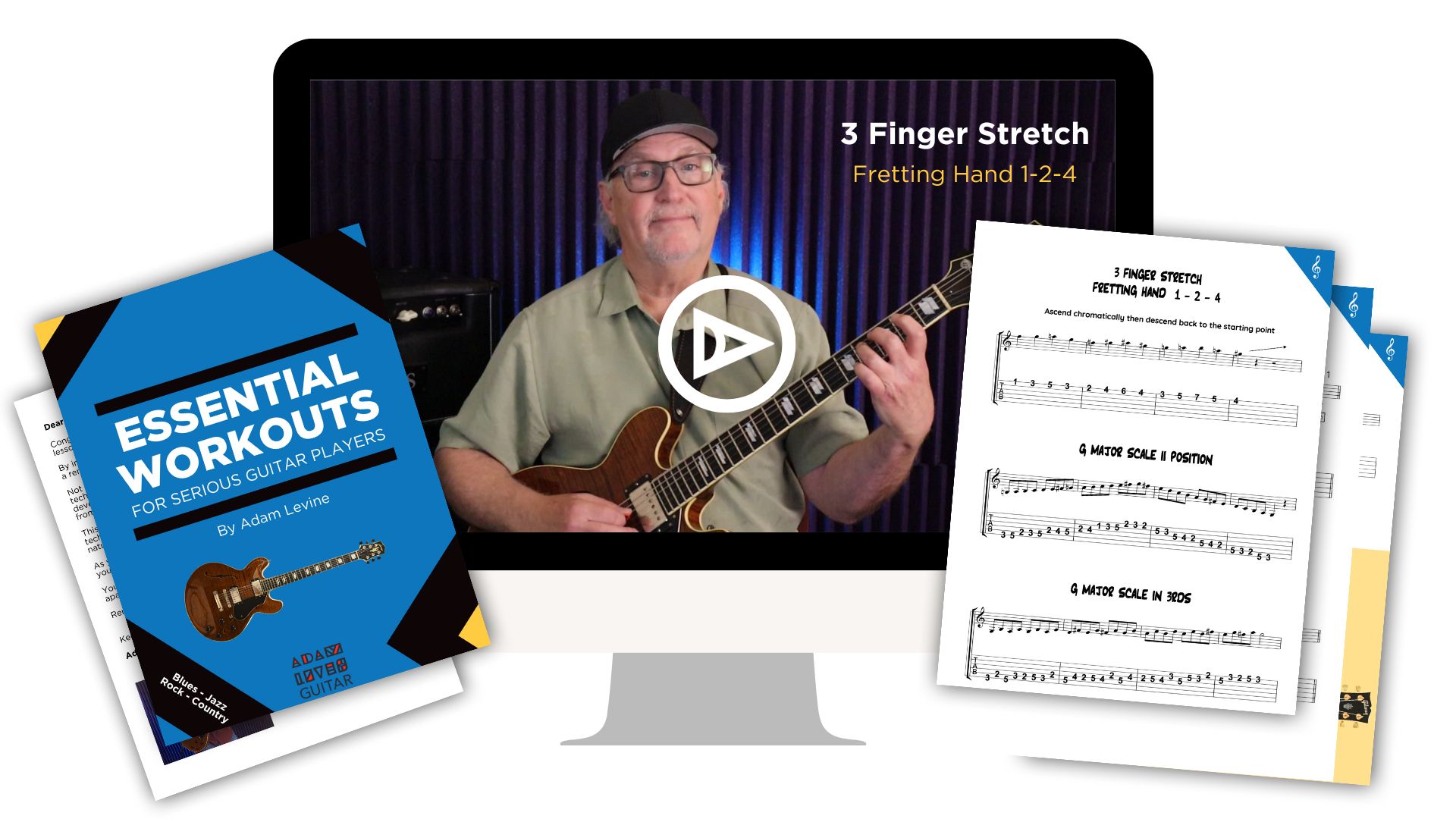
Ready to take this further? Essential Warm-Ups
Build speed, control and dexterity with a daily routine.
The tricky 'turn' on the top strings
On the B string you move two frets and then one, so you can stay in position and play first finger, third finger, pinky. On the high E string, play only two notes — the A at the fifth fret and the B at the seventh.
Here's where it gets tricky: instead of continuing, you turn the pick around. After the B, use an upstroke to reach the G on the B string, and from there everything reverses — up, down, up. That turn is the part that trips people up, so practice it slowly and in even eighth notes, not triplets.
Make it automatic
In real playing Adam goes back and forth between both systems, doing whatever makes sense — if it's natural to follow through with a downstroke in a lead, he does. Practice these enough and it becomes intuitive: your pick just moves in the most ergonomic way without you thinking about it.
For players ready to take this all the way, Adam lays out his complete professional system — rhythm, melody and harmony as one language — in The Method.