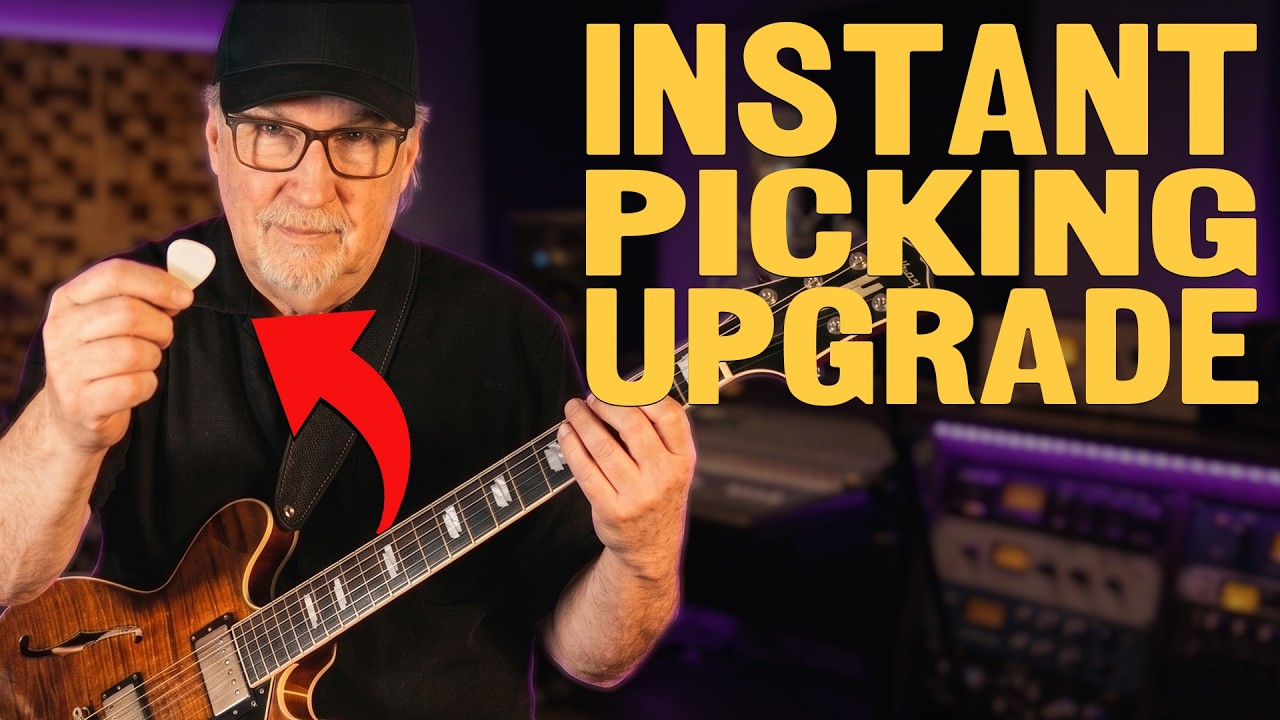
Amazing Beginner Guitar Chords - thousands of songs with these 16 guitar chords

► Watch the full lesson on YouTube
Learn just sixteen open chords and you can play hundreds — if not thousands — of popular songs by the Beatles, the Eagles, James Taylor, Paul Simon and the Rolling Stones. Here's how to memorize them, connect them, and practice them.
What you'll learn
- Sixteen essential open chords unlock a huge chunk of popular music
- Three chord types: major (bright), minor (somber), dominant 7 (bluesy)
- Smooth your chord changes by strumming open strings on the last upstroke while you reshape
- Memorize shapes with the squeeze-and-return trick; the F bar chord is the tough one
The three chord types
Before the shapes, know the three types. A major chord has a bold, happy, bright sound. A minor chord is more somber — some call it sad. A dominant seventh chord (written just as "7," like E7) has a funky, bluesy sound. Eventually you want to play each type from any letter, but for now we'll learn sixteen specific chords.
We start on E because it's the lowest note on the guitar, then move roughly alphabetically with a few exceptions. Depending on the chord, you'll strum six, five, or four strings — so go string by string at first to make sure every note rings out.
E, G and A
From E, learn E major, E minor, and E7 — on the E7, make sure the open D string rings, since that's its flavor (there's also an alternate E7 that adds the pinky on the 3rd fret of the B string). On G you only need two: G major and G7. On A there are three — A major, A minor, A7. For the A shapes, use your second, third and fourth fingers so your first finger stays free, mute the low E, and strum from the A string.
Here's the trick every guitarist uses to change chords smoothly: on the last upstroke before the change, lift the hand and strum the open strings, then form the next shape and land on it. It buys you a split second — exactly what you need going from E to A in something like the Eagles' "Peaceful Easy Feeling."
Ready to take this further? The Academy
Go deeper with monthly live workshops, study guides and a community of serious players.
B, C and D
B7 is a four-finger "triangle" shape: middle finger on the 2nd fret of the A string (the root, B), first finger on the 1st fret of the D, ring finger on the 2nd fret of the G, and pinky on the 2nd fret of the high E, with the open B ringing through. B minor is a "stair-step" shape on the top strings (2nd fret of string one, 3rd fret of the B, 4th fret of the G) — strum three strings, or add the open D.
A great way to burn any new shape in: squeeze it so the strings leave impressions on your fingertips, drop your hand to your knee, then come back up and grab the chord, thinking ahead about where each finger goes — repeat three or four times and muscle memory kicks in. On C, learn C major (let the open G and high E ring, skip the low E) and C7 (just add the pinky on the 3rd fret of the G). On D, learn D major, D minor and D7.
The F chord, and how to practice
F is the one that gives beginners trouble, because your first finger has to bar two strings at once — lay it across the 1st fret of the high E and B strings, then add the second finger on the 2nd fret of the G and the third on the 3rd fret of the D (that D-string note is the root, F). Strum the top four strings, or just the top three while you're building it. Don't worry if it's rough at first — the fingers adjust.
To practice, run all sixteen in order (E, Em, E7, G, G7, A, Am, A7, B7, C, C7, D, Dm, D7, F) so you can spot what needs work. A musical practice idea: songs often move up four alphabet letters (E to A, D to G, Em to Am) — it always sounds good. For blues, E7-A7-B7 with a shuffle strum gets you tunes like Route 66 or Kansas City. And a great song to burn these in is the Eagles' "Tequila Sunrise," which uses G, A minor, C, D7, B minor, E7 and E minor. These sixteen are your foundation — build on them and you'll play all the songs you ever wanted to.
For players ready to take this all the way, Adam lays out his complete professional system — rhythm, melody and harmony as one language — in The Method.