Best way to learn the guitar fretboard - Things Every Guitarist Should Know

► Watch the full lesson on YouTube
Do you instantly know every note on the guitar — not after a calculation, but right away? Here's the method Adam uses to truly burn the fretboard in, without the crutches most systems lean on.
What you'll learn
- Aim to know each note instantly — ditch crutches like the octave trick
- Knowing the notes lets you see chords like a pianist and add color tones
- Learn ONE note at a time across all strings — don't climb the chromatic scale
- Practice two ways: drag across the strings playing every C, and a fret-by-fret yes/no
Why crutches hold you back
Lots of systems teach the notes with crutches — the classic one being "skip a string and go up two frets for the octave." It works, but it's a crutch. The goal is to get straight to the answer: see a note and instantly know it's a G♯ without thinking twice.
The payoff is enormous. You actually know what you're playing instead of just shapes, and you start to see chords the way a piano player does. Look at a C chord and you see C, E, G, C and an open E — and once you see that, you can manipulate it: add a D up top for color, or add an A to a G chord to brighten it, because you know those notes will sound good.
Turn the process around
Most people try to learn notes by climbing the chromatic (half-step) scale up one string — E, F, F♯, G… up to the 12th fret. The trouble is you just get good at reciting the alphabet; there's no real challenge, so the notes never stick.
Instead, make a practice session about learning one note. Pick C. The job is to know where every C is on every string.
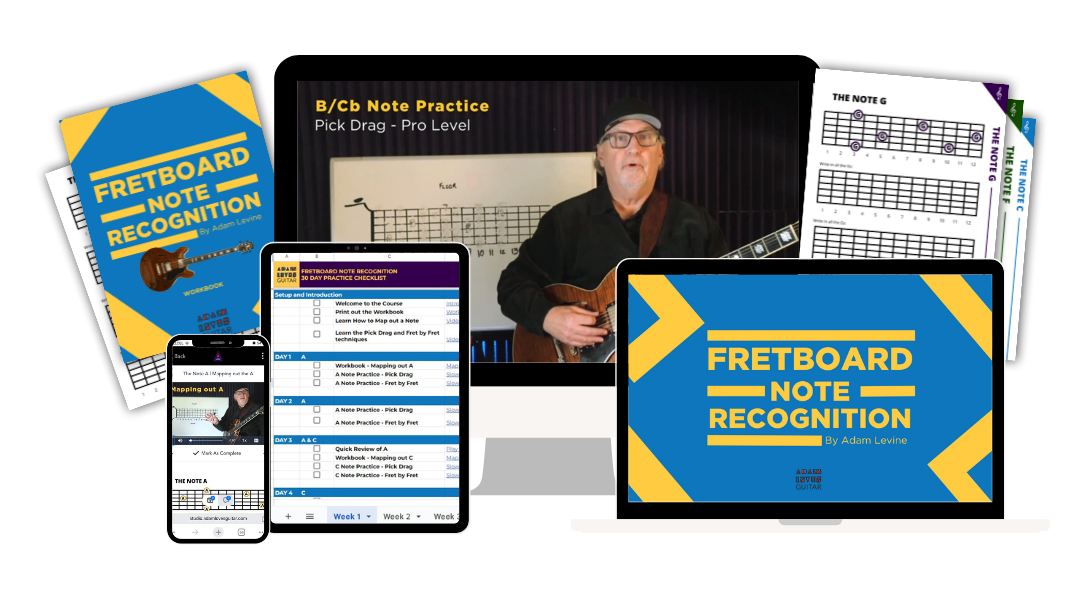
Ready to take this further? 30-Day Fretboard Note Recognition
Lock in every note on the neck with a focused 30-day plan.
Two ways to burn it in
First, across the strings: with pencil and paper, draw a fretboard and map out all the C's. Then drag your pick from the ceiling toward the floor, string by string, playing every C, with a metronome — give yourself four clicks, and bump the tempo up a little each day. Imagine little red LEDs under every C lighting up so you can glance at the neck and see them all.
Second, fret by fret, as a yes/no: "Is there a C at the first fret? Yes. Second? No. Third? Yes…" up to the 12th fret (the guitar just repeats after that). Come back the next day and work a new note, like A, and pretty soon the whole fretboard lights up. As a bonus, this makes pentatonic scales far easier — to play A minor pentatonic, just put your first finger on any A and you're in position.
For players ready to take this all the way, Adam lays out his complete professional system — rhythm, melody and harmony as one language — in The Method.