Guitar pro wow moments - The guitar lesson that changed my life

► Watch the full lesson on YouTube
Two lessons from two legendary teachers changed how Adam sees the guitar — one about the logic of the fretboard, the other about playing the instrument all on its own. Here's what Ted Greene and Joe Pass taught him.
What you'll learn
- The fretboard has a logic — you can play anywhere without jumping to a familiar shape
- Use string sets (1-2-3, 2-3-4, 3-4-5, 4-5-6) and think linearly, not just in one position
- Treat the guitar as a solo instrument, not only a rhythm-section one
- Build a repertoire of tunes you can sit down and play by yourself
The fretboard has a logic
Adam was fortunate to study with Ted Greene — a guitar player's guitar player and a legendary teacher whose approach to the fretboard, in Adam's words, spun his head. For the first time he started to see that there was a logic to the neck.
The lesson that stuck came mid-tune. Adam was playing chords, jumping up the neck to reach the next one, when Ted stopped him and asked, half-joking but stern, "What are you doing?" Adam didn't realize there was a closer option right where his hand already was. The idea that you should be able to put yourself anywhere on the fretboard and play whatever the moment needs in that area — without leaping to a familiar spot — was a turning point.
That opened up thinking in string sets — strings 1-2-3, then 2-3-4, 3-4-5, and 4-5-6 — and seeing the guitar linearly instead of locked in one position. At Berklee, the first year or two kept you in position; it took Adam a while to break out of that and see the neck the way players like Pat Metheny, Mick Goodrick, and John Scofield do.
Play the guitar as a solo instrument
Studying with Joe Pass was just as formative. Adam went to Joe's house, knocked on the door, and Joe opened it in a smoking jacket with a cigar and his Virtuoso album playing on an old hi-fi. They sat down and Joe said, "Play something for me." Adam admitted he could solo through tunes and strum chords, but didn't really have a piece he could play.
Joe's response: you need to be able to sit down in your living room with your guitar and entertain yourself for a couple of hours, the way a piano player would. A light bulb went off. From that day Adam started approaching the guitar as a solo instrument as well as a rhythm-section one — learning tunes like Stella by Starlight and pieces by Duke Ellington and Miles Davis, and building a repertoire.
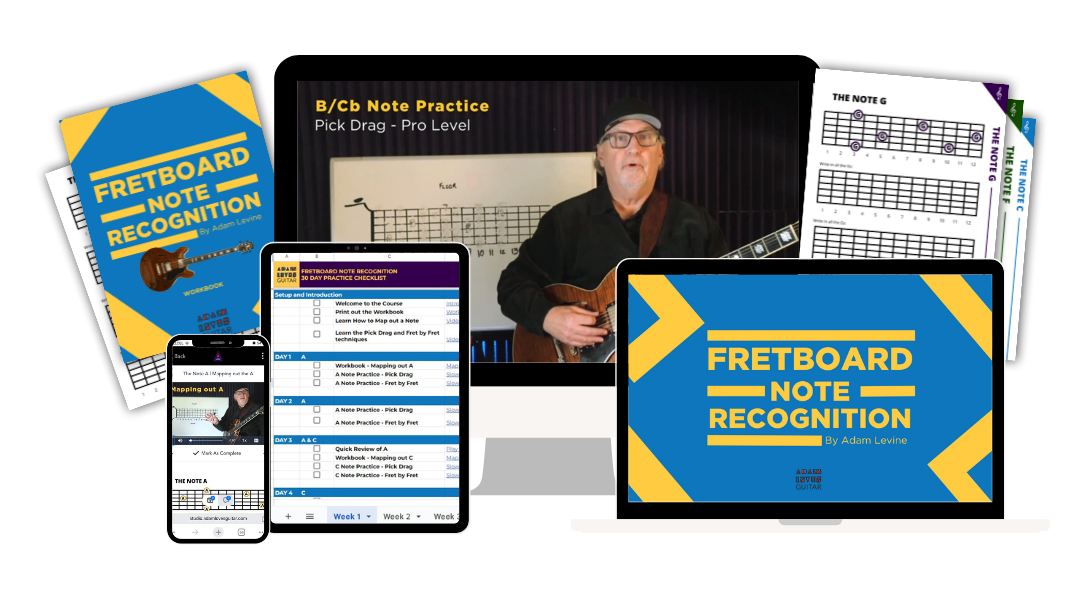
Ready to take this further? 30-Day Fretboard Note Recognition
Lock in every note on the neck with a focused 30-day plan.
What this means for you
It doesn't have to be jazz — it could be fingerstyle or any style. The question worth exploring is simple: what can you play all by yourself that actually moves people? The guitar is a wonderful solo instrument, and there are more great solo players than ever to learn from.
For players ready to take this all the way, Adam lays out his complete professional system — rhythm, melody and harmony as one language — in The Method.