The 4 Best Funk Chords For The Rhythm Guitarist * Bread And Butter Funk Guitar Chords
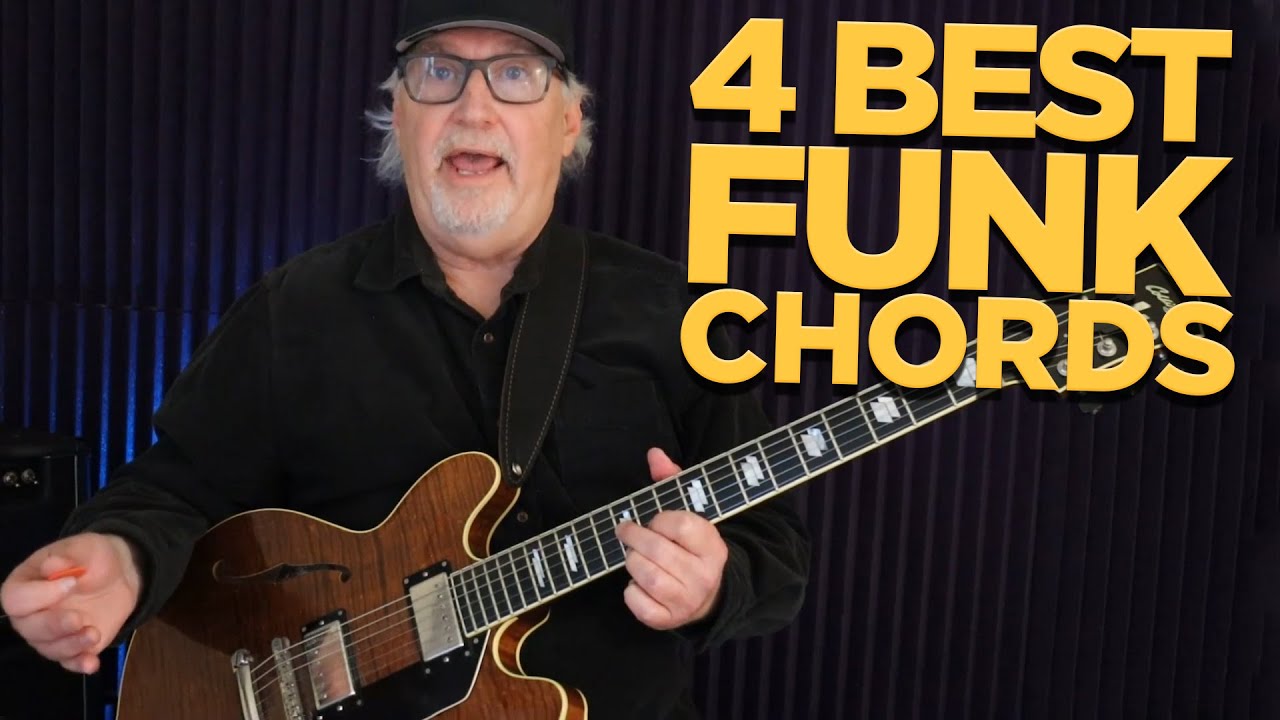
► Watch the full lesson on YouTube
Funk rhythm guitar — the kind you hear in Earth, Wind & Fire and Tower of Power — comes down to a handful of go-to voicings. These are the bread-and-butter dominant 7th chords Adam reaches for about 80% of the time.
What you'll learn
- Funk lives in dominant 7th voicings on the top three or four strings
- Learn each voicing by which chord tone is on top — root, 3rd, 5th, or ♭7
- Leaving out the 3rd gives an open, hollow, funky sound
- Connect keys by sliding a shape until the new chord's tone is on top
Why dominant 7ths, and where to play them
For groove-type funk, Adam concentrates on dominant 7th chords, mostly using the top three or four strings — the ones closest to the floor. Working in C7, the chord tones are C, E, G and B♭ (root, 3rd, 5th, ♭7), and the trick is to learn a voicing built on each one.
A good way to organize it: visualize the chord theory on the first string. Find C at the 8th fret, E at the 12th, G at the 3rd, B♭ at the 6th — then build a small voicing under each of those notes so you always know whether the root, 3rd, 5th, or ♭7 is on top.
The four bread-and-butter voicings
The first has the root on top — solid and right in the pocket. From the D string down it stacks the ♭7, the 9th (D, for a jazzy color), the 5th, and the root. Notice there's no 3rd, which opens it up and gives it a hollow but still funky sound.
Then there's a voicing with the 5th on top (B♭, C, G — ♭7, root, 5th), a ♭7 voicing across four strings that also has the 9th in it, and a 3rd-on-top voicing that looks like a D7 shape slid up the G, B and E strings (12th, 11th, 12th). On that last one, Adam likes to suspend the third — push the note on the high E up to F and bring it back.
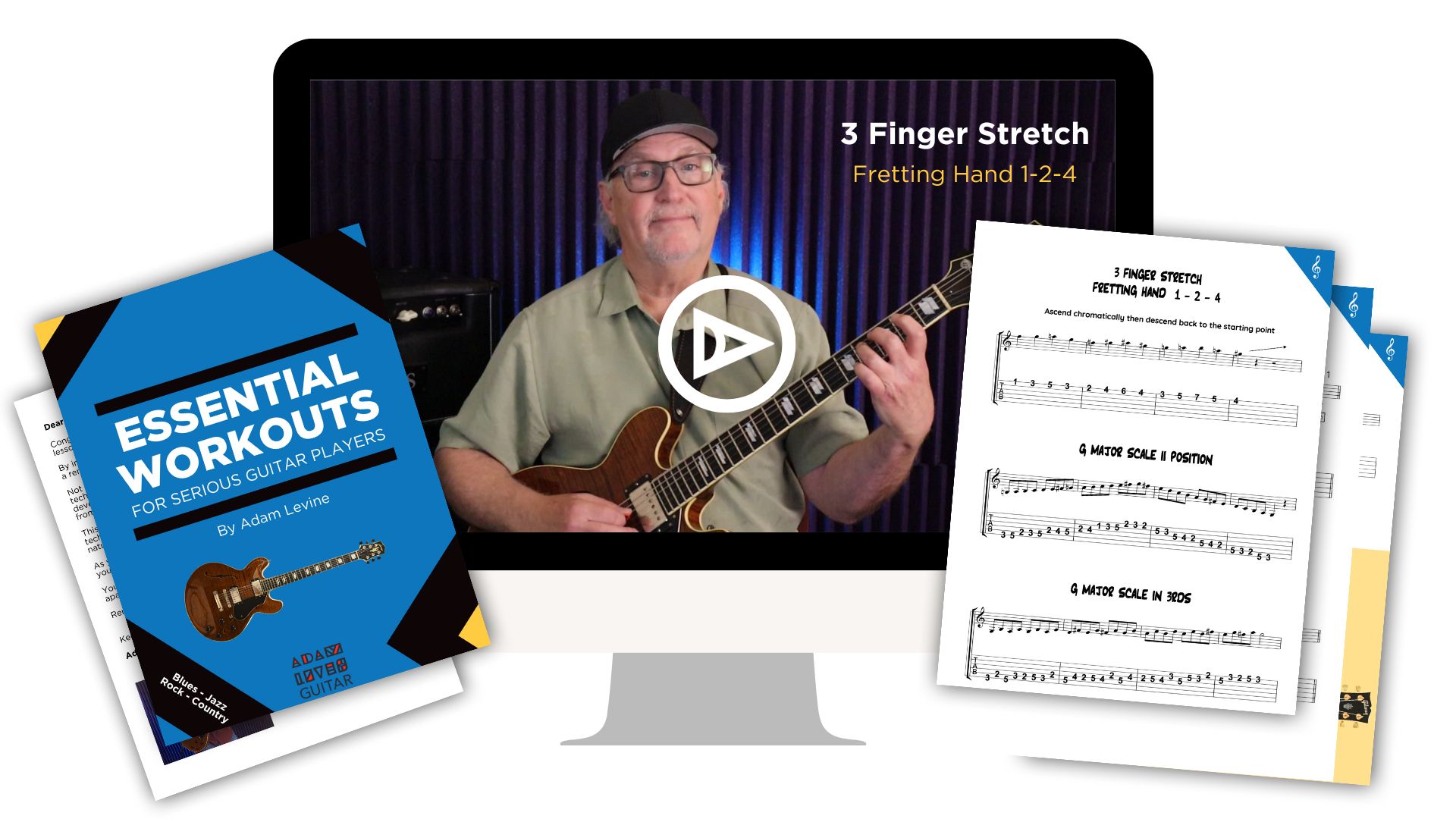
Ready to take this further? Essential Warm-Ups
Build speed, control and dexterity with a daily routine.
Connecting from one key to the next
Once you know the voicings by their top note, changing keys is easy. Say you're going from C7 to F7: the 3rd of F7 is A, so take your 3rd-on-top C7 shape and move it until the A is on top — now it's an F7 funk chord that connects smoothly. There's always something close by to move into.
From there you embellish — for example, instead of jumping straight up to the B♭-on-top voicing, walk from the G up to A and then to the B♭. It's all still C7, just with movement.