The Ultimate First Guitar Lesson - Everything You Need To Get Started On Guitar

► Watch the full lesson on YouTube
Your first lesson on the guitar — but with a twist. Instead of getting stuck in one position for months, Adam starts you with the underlying logic of the instrument: the notes, the strings, how the fretboard works, and your first two chords and song.
What you'll learn
- There are 12 notes in music; B goes straight to C and E straight to F (no sharp in between)
- Hold a medium pick correctly and practice the rest stroke
- Learn the string names with "Elephants And Dogs Grow Big Ears" (E A D G B E)
- The major scale formula is whole-whole-half-whole-whole-whole-half; your first chords are G and D7
The 12 notes
There are 12 notes in music, like the hours on a clock, and they cycle. Starting from A they go A, A♯, B, C, C♯, D, D♯, E, F, F♯, G, G♯, and then back to A an octave higher. Each letter is usually followed by its sharp — with two exceptions: B goes directly to C, and E goes directly to F.
The whole approach here is to understand this logic up front so you can move around the neck from the start, rather than slowly working your way up the fretboard over months.
Holding the pick and the rest stroke
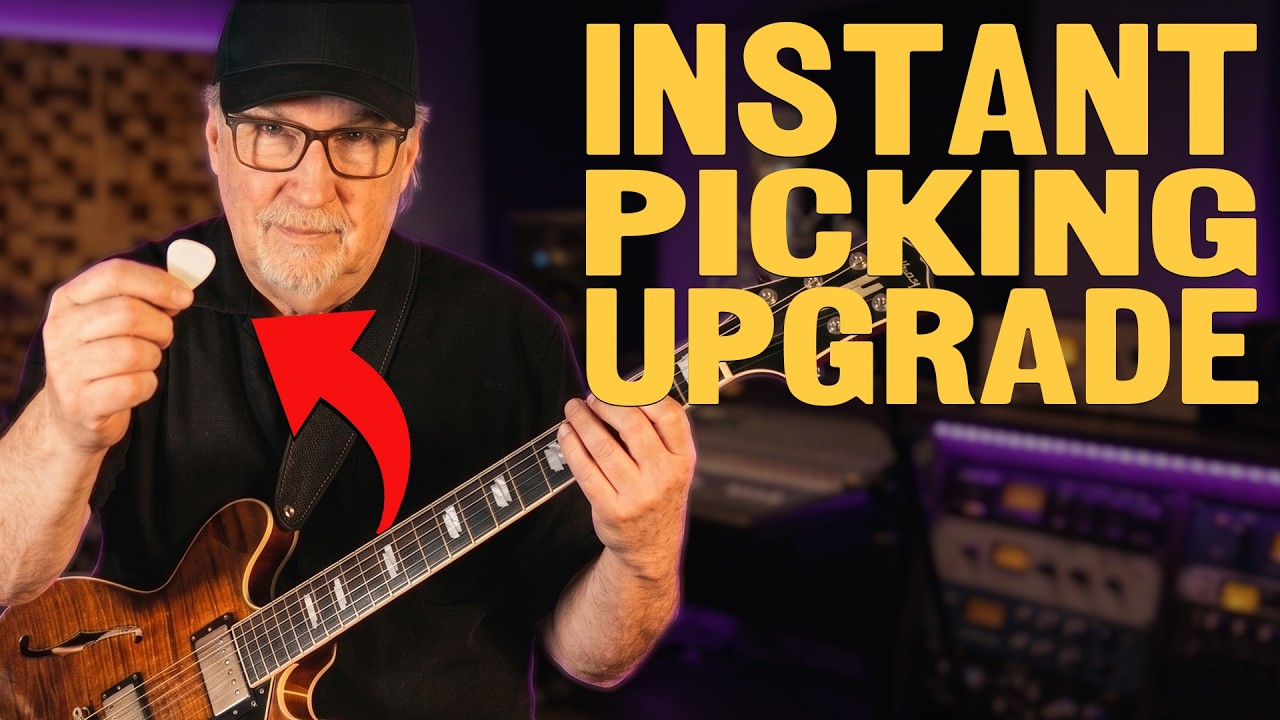
Put the tip of the pick under your thumb and bring your first finger up to press it in place, aligning the tip roughly with the cuticle of your thumb. Don't hold it loosely out at the end (it'll flap and fall), and use a medium pick — too thin gives a flappy, thin sound.
Then practice the rest stroke: pick a string and follow through so the pick comes to rest against the next string. Work from the string closest to the ceiling toward the floor, one rest stroke at a time, until the last string where there's nothing to stop the pick.
Naming the strings and fretting a note
The six strings, from the one closest to the ceiling to the one closest to the floor, are E, A, D, G, B, E. A student of Adam's came up with the perfect way to remember them: "Elephants And Dogs Grow Big Ears." Ask yourself for the D string and you just think "Elephants And Dogs" — third one down.
To get a clean note, press the string just behind the metal fret — not on top of it, which causes a buzz. Unlike a fretless violin, the guitar's frets do the work: pressing down shortens the vibrating part of the string. Notice the 12th fret has two dots; that's where each string's name repeats an octave higher (the open A and the 12th-fret A are both A).
Half steps, whole steps, and the major scale
A half step is one fret; a whole step is two. One thing that feels backwards at first: moving toward the floor raises the pitch, moving toward the ceiling lowers it — we speak in terms of pitch, not physical direction. The note on the 1st fret of the B string, by the way, is middle C, the same C that sits in the middle of a piano.
The major scale has a fixed formula: whole, whole, half, whole, whole, whole, half. Start on C and follow it and you get the C major scale (Do, Re, Mi, Fa, Sol, La, Ti, Do). Start on any other note — say E on the 2nd fret of the D string — apply the same formula, and you get that note's major scale. (Fun aside: songs that open on an octave, like "Somewhere Over the Rainbow," are famously hard to sing for exactly that reason.)

Ready to take this further? Best Minor Pentatonic Course
Turn scales into solos that actually sing.
Your first chords — G and D7
A chord is more than one note played at once. For a simple G, place your third finger on the 3rd fret of the high E string and strum four strings, making sure each note rings. A fuller G adds the second finger on the 3rd fret of the low E (it'll lightly mute the A string, which is fine).
For D7, come from the simple G, slide that finger back to the 2nd fret, add your first finger on middle C (1st fret of the B string), and your second finger on the 2nd fret of the G string — a little triangle shape — then strum five strings. As you practice, stop placing fingers one at a time and start "plugging the whole shape in like a lamp": grab the chord, squeeze so the strings press into your fingertips, rest your hand on your knee, then bring it back and form the shape all at once. That's how the muscle memory builds.
Your first song
Put the two chords together on Hank Williams' "Jambalaya" — a great first song (most Hank Williams tunes use just two or three chords). Play two measures of G, two of D7, then flip to two measures of D7 and two of G, strumming on beat one to start. Count it off "four for nothing" — a count-off bar that sets the tempo — and you're playing your first song. The goal of this whole lesson is simply to get you acclimated and show you, conceptually, how the guitar and music actually work.