Transform Your Guitar Playing with 4 Unique Techniques - How to use a guitar capo creatively
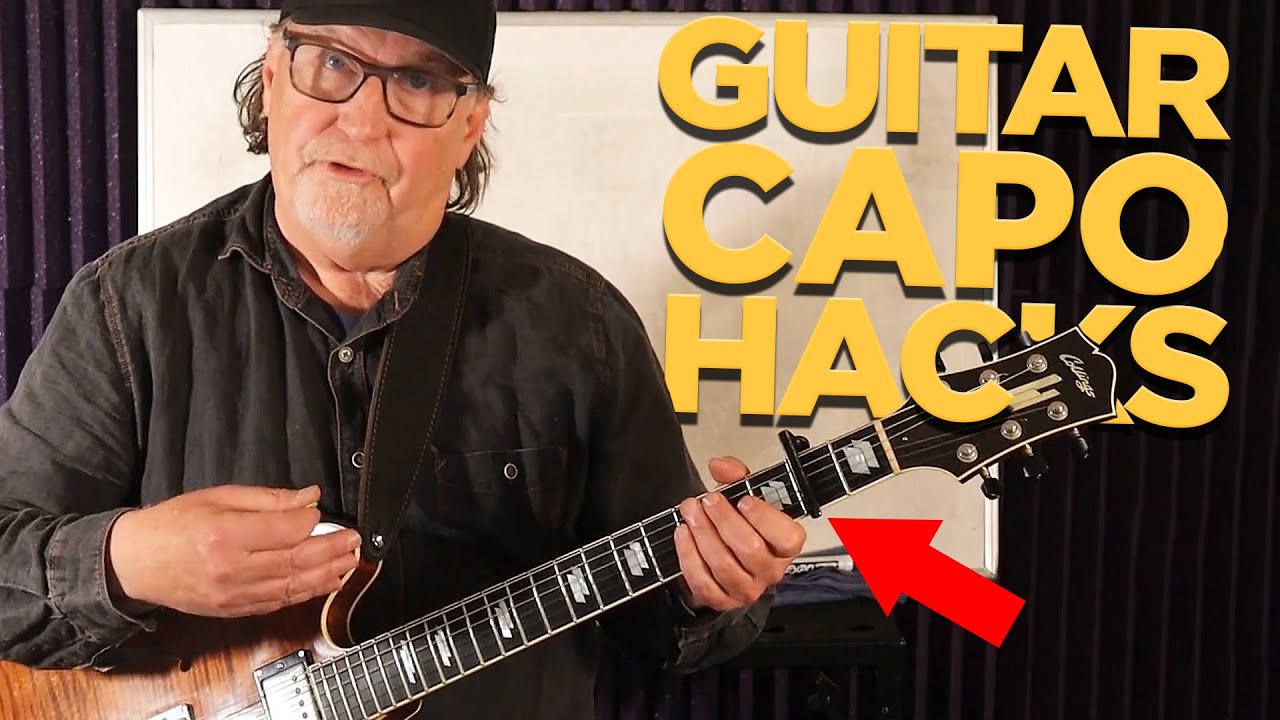
► Watch the full lesson on YouTube
A capo isn't just for changing keys. Adam shows four creative ways to use one — from a bright mandolin shimmer to layering two capo'd parts into one full, glistening sound.
What you'll learn
- Capo + CAGED shapes is the foundation — know where the root is so you know the real chord name
- Capo high (around the 7th fret) for a bright, chimy "mandolin" sound, great for layering and overdubs
- Use a capo to drop a song into an easier open-chord key (e.g., G shapes at the 3rd fret = B♭)
- Transpose with the two-row chromatic trick, then layer two capo'd parts for a full sound
1. The familiar way — change keys
The most familiar use is simply clamping the capo behind a fret and playing as usual. Put it behind the 2nd fret, play a C shape, and you're actually sounding a D chord — if you were with a piano player, you'd ask them for a D. One tip: don't over-tighten the capo, or it can pull the guitar sharp. And the shapes that work best with a capo are the CAGED shapes (C, A, G, E, D).
2. The mandolin sound
Move the capo up high — around the 7th fret and beyond — and play a CAGED shape up there for a bright, chimy, mandolin-like sound; a touch of overdrive makes it sing (it's "Here Comes the Sun" territory). The key is knowing where the root sits in your shape, so you know the real chord: a D shape capoed up high might actually be an A chord. These high capo parts add beautiful shimmer when you layer them live or overdub a second or third guitar in the studio.
Ready to take this further? The Academy
Go deeper with monthly live workshops, study guides and a community of serious players.
3. Lower a song into an easy key
Sometimes a song is in a tough key — F, B♭, or just too high for your voice — and you want open-position chords instead. Say a tune in C is too high and you want B♭. From the CAGED shapes, G is close to B♭ (G, G♯, A, B♭), so capo the 3rd fret, play G shapes, and you're in B♭ — now you can fingerpick those open-style chords with all their ring.
That requires transposing, and Adam's "Poor Man's Guide" makes it easy: draw two rows of twelve blocks. In the top row write the original key's chromatic scale starting on its root (C, C♯, D…). Directly beneath, aligned, write the chromatic scale of the shape you're using (G, G♯, A…). To transpose any chord, find its root in the top row and read the note directly below it, keeping the chord type — so a C13♯11 becomes a G13♯11. Perfect for when a singer at rehearsal needs the song dropped a few half steps on the fly.
4. Layer two capo'd parts
Adam's favorite: overlay two capo'd guitar parts in different areas of the neck for a full, shimmering sound. Take a I-IV like D to G. For the lower layer, capo the 2nd fret and play a C shape (sounding D) to an F shape (sounding G). For the upper layer, capo the 7th fret and play a G shape (sounding D) to a C shape (sounding G). Let the progression go around once, then bring in the second layer — two guitars ringing together, and with bass and drums under it, a genuinely big sound.